
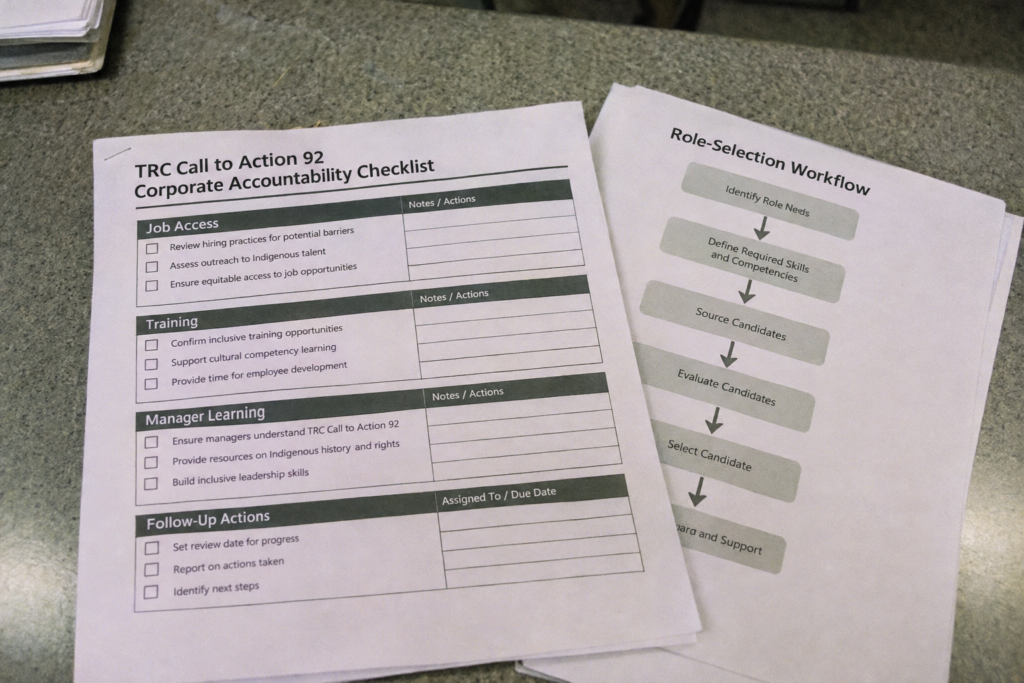
For employers, trc call to action 92 is a practical test of whether Indigenous access to jobs and training is built into decisions, not left to individual goodwill. That matters when public announcements about children and community wellbeing prompt employers to examine whether their own workplaces support durable opportunity without claiming to speak for Indigenous communities.
What trc call to action 92 asks employers to examine
A federal notice says the Honourable Mandy Gull-Masty, Minister of Indigenous Services, and Inuit Tapiriit Kanatami President Natan Obed will announce a new approach to supporting Inuit children. The notice does not describe the approach itself, so employers should not assume what it contains or use it to make claims about Inuit priorities. The announcement is a reason to reflect on employers’ own responsibilities, not a recruitment opportunity to attach a company’s name to community priorities.
Truth and Reconciliation Commission Call to Action 92 is specifically addressed to the corporate sector. It asks companies to provide equitable access to jobs and training, build respectful relationships, and train managers and staff in intercultural competency, conflict resolution, human rights and anti-racism. Employers can use those requests to review actual decisions and workplace practices, rather than treating reconciliation as a communications exercise. Read the text of Call to Action 92.
The announcement notice is available from Indigenous Services Canada. Its subject is support for Inuit children; employers should not present their hiring plans as part of that approach unless the parties involved have explicitly made that connection.
Turn the commitment into accountable decisions
Call to Action 92 does not prescribe one corporate policy or hiring model. Employers need to identify where their own processes affect access: how roles are designed, where they are advertised, how candidates are assessed, what training is available, and what happens when someone raises a concern.
Assign responsibility to leaders who can change those systems. A statement of intent is difficult to assess if no one owns the work, if managers have no guidance, or if senior leaders never review results. Set a review cycle that fits your organisation and record what was changed, who was responsible and what evidence will show whether access or workplace conditions improved.
Start with a short internal review:
- Map the process. Document the path from role approval through recruitment, selection, training and progression.
- Find avoidable barriers. Check whether requirements are genuinely necessary for the work and whether assessment methods test those requirements consistently.
- Name decision owners. Identify who can approve changes to job design, recruitment channels, training and workplace practices.
- Set measures. Choose indicators that reflect access and employee experience, and decide how information will be collected and protected.
- Review and act. Set a regular point to consider findings, assign corrective actions and report progress to leadership.
Make access visible in job design and recruitment
Equitable access begins before a vacancy is posted. Review whether the role’s qualifications reflect the work, whether the schedule and location are fixed for a real operational reason, and whether candidates can understand the selection stages. A process that is clear and consistent gives applicants a fairer opportunity to demonstrate relevant skills.
Recruitment teams should also check that outreach is not the only change made. A job advertisement can invite Indigenous applicants, but access is limited if the assessment criteria are unclear or if hiring decisions rely on informal impressions. For practical checks on the advert itself, use this guide to Indigenous job advert wording, then compare its recommendations with your full selection process.
Before opening a role, decide how the organisation will explain the work, the requirements and the process to candidates. Give interviewers structured questions and a shared assessment method. After selection, check whether decisions were made against the stated criteria; do not ask candidates to represent a whole community or to disclose personal information unrelated to the job.
Measure progress without confusing reporting with impact
Employers need evidence to know whether access is changing, but measurement should have a clear purpose. Decide what information is necessary, who can access it, how it will be used and how privacy will be protected. Do not treat an employee’s willingness to self-identify as proof that a workplace is inclusive, or as a substitute for examining recruitment and retention patterns.
The Employment Equity Act applies to federally regulated employers, not every Canadian employer. Covered employers report each year on the representation of four designated groups; the Labour Program uses the term Indigenous people for one of those groups. Employers outside that reporting framework should not describe its reporting requirements as universal. Any organisation collecting workforce information should set out its purpose and handle it responsibly.
Use both process and experience indicators. Process measures might include whether interview panels use consistent criteria or whether managers complete required learning. Experience measures can include whether employees know how to raise concerns and whether those concerns receive a timely, fair response. Review results in context, avoid drawing conclusions from small or incomplete data, and use findings to change the system rather than putting responsibility on individual employees.
Build training around the work managers actually do
Call to Action 92 names intercultural competency, conflict resolution, human rights and anti-racism. Training should help managers apply those areas to workplace decisions: giving feedback, responding to conflict, evaluating performance and addressing discriminatory conduct. A one-time session cannot replace clear expectations, accessible reporting routes and consistent follow-through.
Decide who needs which learning and what managers must be able to do afterward. Give supervisors guidance for handling concerns respectfully, including when to seek specialist advice rather than attempting to resolve an issue informally. Review whether training is reflected in management practice, and update it when policies, job structures or recurring workplace concerns show a gap.
Onboarding is one point where an employer can make expectations and support clear. Set out the role, workplace policies, available contacts and how employees can request help; then check that the promised support is working. This Indigenous employee onboarding plan can help employers examine the transition beyond the first day without treating onboarding as a substitute for ongoing management responsibility.
Work with Indigenous employment services on practical pathways
Where an employer needs training or support to connect roles with local candidates, start by understanding the service providers available in the relevant community. The Indigenous Skills and Employment Training (ISET) Program is run by Employment and Social Development Canada and funds Indigenous service delivery organisations to design and deliver training locally. An employer works with a local organisation, not directly with the department.
ISET has separate labour market strategies for First Nations, Inuit, Metis, and urban/non-affiliated Indigenous people. Identify the organisation whose service area and work fit your hiring needs, then discuss the role requirements, timing, training needs and what a realistic hiring process can support. Employers and job seekers can find a local ISET service delivery organisation. This is a way to explore an employment pathway, not a guarantee of candidates or a reason to design training without the organisation’s input.
Make the employer’s part explicit: provide accurate role information, keep selection criteria stable, identify who will make hiring decisions and communicate changes promptly. If the work changes or a vacancy is paused, tell the service provider rather than leaving candidates and trainers to rely on outdated information. Respectful coordination is demonstrated through reliable conduct, not through the number of organisations listed as partners.
Keep workplace experience and response systems in scope
Hiring access alone does not meet the full intent of Call to Action 92. Employers should assess whether new employees can understand expectations, access development and raise concerns without being made responsible for educating colleagues about Indigenous peoples. Review the quality of supervision, the consistency of performance feedback and whether advancement decisions use transparent criteria.
Make reporting routes understandable and explain what happens after a concern is raised. Managers should know when to listen, how to document appropriately and when to involve the people responsible for workplace investigations or human rights matters. Do not promise confidentiality beyond what the organisation can provide, and do not treat informal conversations as a reason to avoid established procedures.
For an employer with operations across provinces and territories, confirm which employment rules apply to each workplace rather than assuming one jurisdiction’s requirements cover the whole organisation. Federally regulated employers also need to distinguish their Employment Equity Act reporting duties from broader organisational commitments. Legal compliance is a baseline; the corporate-sector requests in Call to Action 92 remain a useful lens for evaluating workplace practice.
Use evidence to decide what to improve next
At a leadership review, bring together evidence from job design, recruitment, training, employee feedback and the handling of concerns. Ask where the process worked as intended, where it created friction and what the organisation changed in response. Keep the discussion focused on decisions within the employer’s control rather than expecting Indigenous employees or partner organisations to validate the employer’s progress.
Set a small number of specific next actions, give each one an owner and review whether it was completed. If the evidence is incomplete, identify what information is missing and whether collecting it is appropriate. If a practice did not improve access or workplace experience, revise it instead of repeating the same commitment in a new policy or public statement.
That discipline gives employers a practical way to act on trc call to action 92 while keeping the announcement about Inuit children in its proper context. To reach Indigenous candidates for your next role, post a job on Indigenous Hire.